DIY Boredom Buster Jar: Free Printable Activity Cards

Summer screen time goes up. According to a Lingokids survey (2024), 68% of children use technology significantly more during summer break. Parents want solutions. The boredom jar is one of the few that actually works in practice — not just on Pinterest.
This post explains exactly why it works (there is a real psychological mechanism, not just “fun activities on strips of paper”), then gives you 60 printable activity cards you can cut out today and use this afternoon.
Why boredom jars actually work (the mechanism)
Most “boredom busters” fail because they require the parent to generate options on demand while already managing multiple competing demands. By the time a child is reaching for a screen, the parent’s decision fatigue is often at its peak — which is exactly when generating creative alternatives is hardest.
A boredom jar solves this by doing the decision-making work in advance, when the parent has cognitive bandwidth. The cards in the jar represent options the parent already pre-approved. When the child says “I’m bored,” the answer is “pick a card from the jar” rather than “let me think of something.”
For the child, this works because of choice architecture. Research on decision-making with children shows that having a bounded set of visible options — a jar full of cards rather than an infinite screen of content — reduces decision paralysis and produces faster, more satisfying selections. The physical act of reaching in and drawing a card also introduces a random element that children find genuinely engaging (it is why Advent calendar formats remain popular).
Per Pew Research (October 2025), 28% of parents give into screen time to avoid a meltdown or tantrum multiple times per week, and 34% have turned to screens when childcare was unavailable. The boredom jar is not a substitute for childcare, but it is a system that reduces the friction of the transition away from screens in low-supervision moments.
How to set up your jar
Materials:
- A mason jar, large mug, or any container you have
- The printed and cut activity cards (instructions below)
- Optional: color-code them with a marker dot by category
Color-coding system (from practitioner formats):
- Yellow strip = quiet activity (can be done solo, low energy)
- Orange strip = craft or creative (supplies needed)
- Green strip = active (requires space to move)
- Blue strip = outdoor (weather dependent — these can be a separate jar)
Keep the jar somewhere visible — on the kitchen counter, not in a drawer. Visibility is part of the system.
The rule: When a child says “I’m bored” and a screen is not the answer you want to give, they go to the jar and draw one card. They do not get to put it back and draw again (this eliminates the “I don’t like any of these” loop). If a card genuinely requires supplies you do not have, they swap it for one more draw.
The 60 printable activity cards
Print this page and cut along the cards. Each card is formatted as a complete activity brief with supplies and estimated time. Cards are organized by category for easy color-coding before you add them to the jar.
Yellow cards: Quiet activities (solo, low-prep)
Card 01 Draw a map of your house, backyard, or an imaginary kingdom. Supplies: paper, pencil. Time: 30–60 min.
Card 02 Write a letter to a grandparent or friend and address a real envelope. Supplies: paper, envelope, stamp. Time: 20–45 min.
Card 03 Make up the words to a new song and perform it. Supplies: nothing. Time: 20–40 min.
Card 04 Draw portraits of every person in your family, including pets. Supplies: paper, pencils or markers. Time: 30–60 min.
Card 05 Make a list of 10 things you want to do before your next birthday. Supplies: paper, pencil. Time: 15–30 min.
Card 06 Write a story that starts with: “The last dragon in the world woke up and discovered…” Supplies: paper, pencil. Time: 30–60 min.
Card 07 Sort your books, toys, or collections by color. Then rearrange them by size. Supplies: whatever you are sorting. Time: 20–40 min.
Card 08 Make up a new game with rules and write down how to play it. Supplies: paper, pencil. Time: 30–50 min.
Card 09 Origami: learn to fold one new shape. Supplies: square paper (use printer paper cut to a square). Time: 20–40 min.
Card 10 Read three poems and write your favorite line from each in a notebook. Supplies: poetry book or printed poems. Time: 20–30 min.
Card 11 Design your dream bedroom on paper (top-down view). Supplies: paper, ruler, pencil. Time: 30–50 min.
Card 12 Invent a new animal. Draw it and write what it eats and where it lives. Supplies: paper, pencil or markers. Time: 20–40 min.
Card 13 Make a comic strip — 6 panels, a character, a problem, a solution. Supplies: paper folded into panels, markers. Time: 30–60 min.
Card 14 Make a word search puzzle for someone else in your family to solve. Supplies: graph paper or lined paper, pencil. Time: 20–40 min.
Card 15 Look out a window for 10 minutes and write or draw five things you notice. Supplies: paper, pencil. Time: 15 min.
Orange cards: Craft and creative activities
Card 16 Build the tallest freestanding tower using only newspaper and tape. Supplies: newspaper, tape. Time: 25–45 min. Age note: ages 6+ recommended.
Card 17 Make a sock puppet and put on a 5-minute show. Supplies: old sock, markers, optional craft scraps. Time: 30–50 min.
Card 18 Watercolor resist painting: draw with a white crayon, then paint over it. Supplies: watercolor paper or cardstock, white crayon, watercolors. Time: 30–50 min.
Card 19 Decorate a plain tote bag, pillowcase, or old t-shirt with fabric markers. Supplies: fabric item, fabric markers. Time: 30–60 min.
Card 20 Make a model of your neighborhood using cardboard boxes. Supplies: cardboard, tape, markers. Time: 60–120 min.
Card 21 Create a complete board game with rules and a path. Supplies: cardboard, markers, die, small objects as tokens. Time: 60–120 min.
Card 22 Make a collage using only magazine pages and glue. Supplies: old magazines, scissors, glue, paper backing. Time: 30–60 min.
Card 23 Paper airplane design challenge: which design flies farthest? Supplies: printer paper. Time: 30–50 min.
Card 24 Tie-dye effect on coffee filters with liquid watercolors. Supplies: coffee filters, liquid watercolors, rubber bands. Time: 20–40 min.
Card 25 Make a friendship bracelet using embroidery floss. Supplies: embroidery floss, tape to hold it. Time: 45–90 min. Age note: ages 7+ recommended.
Card 26 Draw a before-and-after illustration of one room in your house. Supplies: paper, pencil or markers. Time: 30–60 min.
Card 27 Make up a recipe for a new food. Write it out with ingredients and steps. Supplies: paper, pencil. Time: 20–35 min.
Card 28 Build something with only materials from the recycling bin. Supplies: recycling bin contents, tape. Time: 45–90 min.
Card 29 Make a mini book: fold paper into pages, write and illustrate a story. Supplies: 3 sheets paper, stapler, markers. Time: 45–75 min.
Card 30 Shadow tracing: use a desk lamp and trace the shadow of an object. Supplies: desk lamp, paper, tape, pencil. Time: 30–50 min.
Green cards: Active indoor activities
Card 31 Indoor obstacle course: use furniture, cushions, and tape to mark the route. Supplies: household furniture, painter’s tape. Time: 25–45 min.
Card 32 Balloon keep-up challenge: don’t let it touch the ground. Add body-part rules. Supplies: one inflated balloon. Time: 20–40 min.
Card 33 Freeze dance party: when the music stops, hold your position. Supplies: phone or speaker for music. Time: 20–40 min.
Card 34 Indoor hopscotch with painter’s tape on a hard floor. Supplies: painter’s tape. Time: 25–45 min.
Card 35 Set up a living room bowling alley with plastic bottles and a soft ball. Supplies: water bottles, soft ball. Time: 30–50 min.
Card 36 Teach your pet a new trick, or practice one it already knows. Supplies: pet treats. Time: 20–40 min.
Card 37 Build a pillow fort and read a whole book inside it. Supplies: blankets, pillows, chairs, books. Time: 60–120 min.
Card 38 Paper plate ring toss: cut centers out of plates, toss onto bottles. Supplies: paper plates, bottles or cups. Time: 25–40 min.
Card 39 Create a relay race course and time yourself doing it multiple ways. Supplies: chairs or objects as markers, phone timer. Time: 25–40 min.
Card 40 Towel ball toss: two people hold corners of a towel and launch a ball. Supplies: kitchen towel, soft ball. Time: 20–35 min.
Blue cards: Outdoor activities
Card 41 Chalk town: draw roads, parking spots, and buildings on the driveway. Supplies: sidewalk chalk. Time: 45–90 min.
Card 42 Nature scavenger hunt: find 10 items from a list (rock, feather, yellow flower…). Supplies: list, small bag. Time: 30–60 min.
Card 43 Spy training course: set up a “laser” grid in the yard with string. Supplies: string, two trees or posts. Time: 30–50 min.
Card 44 Mud kitchen: fill a pot with soil and water and cook something imaginary. Supplies: old pot, spoon, soil, water. Time: 60–120 min.
Card 45 Bubble experiment: try 5 different bubble wand shapes. Supplies: bubble solution, pipe cleaners to shape wands. Time: 30–50 min.
Card 46 Set up a nature museum: collect and display 10 items with labels. Supplies: natural objects, index cards, marker. Time: 45–75 min.
Card 47 Paint rocks: find smooth rocks, paint them, leave one somewhere for someone to find. Supplies: outdoor rocks, acrylic paint, sealer optional. Time: 45–75 min.
Card 48 Bird watching: sit quietly outside for 15 minutes and record every bird you see. Supplies: paper, pencil, binoculars optional. Time: 20–30 min.
Card 49 Make a sundial using a stick in the ground. Check it every hour. Supplies: a straight stick, stones to mark hours. Time: ongoing throughout the day.
Card 50 Water balloon science: which balloon shape holds the most water? Supplies: water balloons, measuring cup. Time: 20–40 min.
Bonus cards: Cooking and kitchen projects
Card 51 Make homemade ice cream in a bag (heavy cream + sugar + salt + ice + bag). Time: 30 min. Adult supervision required.
Card 52 Decorate store-bought cookies with icing and sprinkles. Time: 30–45 min. Ages 4+ recommended.
Card 53 Make a smoothie using only things in the fridge. Name your creation. Time: 15–25 min. Adult supervision for blender.
Card 54 Peel and slice fruit to make a fruit salad for the whole family. Time: 20–35 min. Ages 7+ with age-appropriate knife supervision.
Card 55 Make your own salad dressing from scratch. Taste-test it on lettuce. Time: 15–25 min.
Wildcard cards: challenges and connection
Card 56 Teach an adult in your house one thing you know how to do really well. Time: 20–40 min.
Card 57 Make a time capsule: seal 5 items in an envelope with today’s date. Time: 30–50 min.
Card 58 Plan a family game night: choose three games and write the order. Time: 20–30 min.
Card 59 Call or video call a grandparent or relative and ask them to tell you a story. Time: 20–45 min.
Card 60 Go to bed 30 minutes early and read with a flashlight under the covers. Time: 30–60 min.
Printable instructions
Print this page (or the cards only), cut along the card borders, and fold each card once. If you are color-coding them, use a marker to add a colored dot before adding to the jar. The jar is ready.
Two notes from practitioner guidance: First, put the jar somewhere visible. Out of sight means out of mind when a child is already in screen-grab mode. Second, refresh the jar periodically — add the cards they have not drawn yet to the front of the pile, or add new cards as you find activities your child responds to.
For more structured activity resources, see the Free Printables category and our 47 screen-free activities for ages 5–8 for a longer curated list. For a single-page fridge format, the Rainy Day Activity Menu gives you 20 pre-selected activities on one printable sheet — a faster reference when you need something immediately. If you want a structured one-week system rather than a jar, the Screen-Free Week Challenge Chart is a seven-day tracker with one activity challenge per day and a sticker box your child fills in.
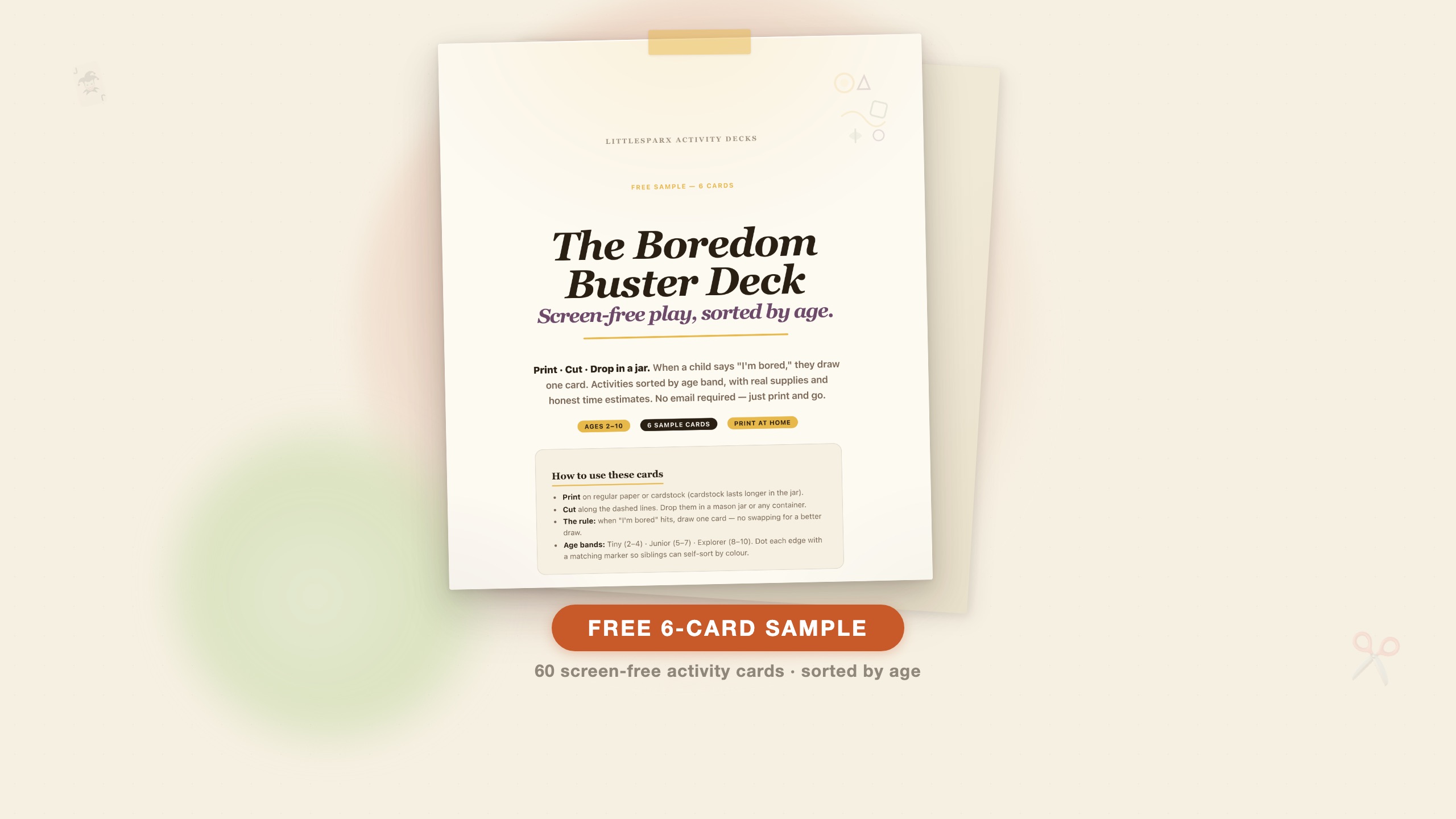
:::tip[Free printable deck] We turned these 60 cards into a formatted, print-ready PDF deck — the Boredom Buster Deck free sample (6 cards, no email required) is available now. The full 60-card pack with cut lines and toddler safety flags is at /products/boredom-buster-deck. :::
Common questions
What age is the boredom jar for?
The cards in this set are designed for ages 5–10, with age notes on cards that have specific age requirements. For children under 5, simplify the cards (shorter instructions, physical rather than written activities) and draw the card with them rather than sending them to the jar independently.
My child just puts the card back and grabs the screen anyway. What do I do?
The jar works better as a transition tool than a replacement for parental follow-through. The card is the bridge. Sit with them for the first 5–10 minutes to get the activity started, then step back. The friction point is starting, not sustaining — most activities on this list produce longer engagement once they are underway.
Should I give a reward for using the jar?
Practitioner guidance on extrinsic rewards is cautious here: rewarding a child for not using screens can inadvertently frame screen time as the desirable default that merits a substitute reward. The jar works best as a neutral option rather than an earned prize system. If your child needs more incentive, letting them earn a later screen time by completing a jar activity is a workable approach without framing non-screen time as a sacrifice.
What if they draw the same card repeatedly?
Let them. Repeated engagement with a preferred activity is developmentally appropriate. If the same card comes up because they drew it repeatedly (rather than by chance), it is a signal about what they actually enjoy — and that is useful information.
Heads up: this post contains affiliate links. If you buy through them we may earn a commission at no extra cost to you — it's how we fund independent research. Full disclosure.